
Can Artists Retire?
Like anyone, Artists should be able to retire and be able to enjoy a period of life where they don’t have to work. Artists are able to retire if they make more than enough money to survive in order to save money in retirement plan over a long period of time.
There are many options available to artists (and all people who are self-employed) to prepare for retirement . The first type of plan that artists should consider when planning for retirement is a solo 401K. This is similar to the type of 401K plans traditional employees can contribute to, but they provide the benefit to of allowing contributions to it as both an employee and an employer. For 2026, an artist can contribute 100% of their earned income up to $24,500 as an employee and up to 25% of their compensation as an employer (if they under 50). Artists cannot have any W-2 employees (aside from your spouse) to have a solo 401K. If an artist takes on a W2 employee, the solo 401K must covert to a traditional 401k.
Another type of account that artists should consider when planning for retirement is a simplified employee pension IRA (SEP IRA). A SEP IRA is similar to solo 401K, however, artists are only able to contribute to them as employers. For 2026, artists can contribute the lesser of 25% of their compensation or $72,000. SEP IRAs allow artists to have employees, but the artists will have to contribute the same amount to their employee’s account as their own.
Another type of account that artists should consider when planning for retirement is a savings incentive match plan for employees (SIMPLE IRAs). A SIMPLE IRA is simple to a SEP IRA, but has different contribution rules. Artists can defer up to $17,000 of their salary in 2026 as employees subject to cost of living adjustments. As an employer, they are required to make a contribution every year. The contribution must match employee contributions dollar-for-dollar up to 3% of their compensation (or 4% under new SECURE 2.0 rules for some employers), or make a flat 2% contribution to all eligible employees regardless of whether employees contribute.
Lastly, many states (and few cities) have state-administered retirement savings programs that artists (and any self-employed person) is eligible to join.
Estate Planning for Artists
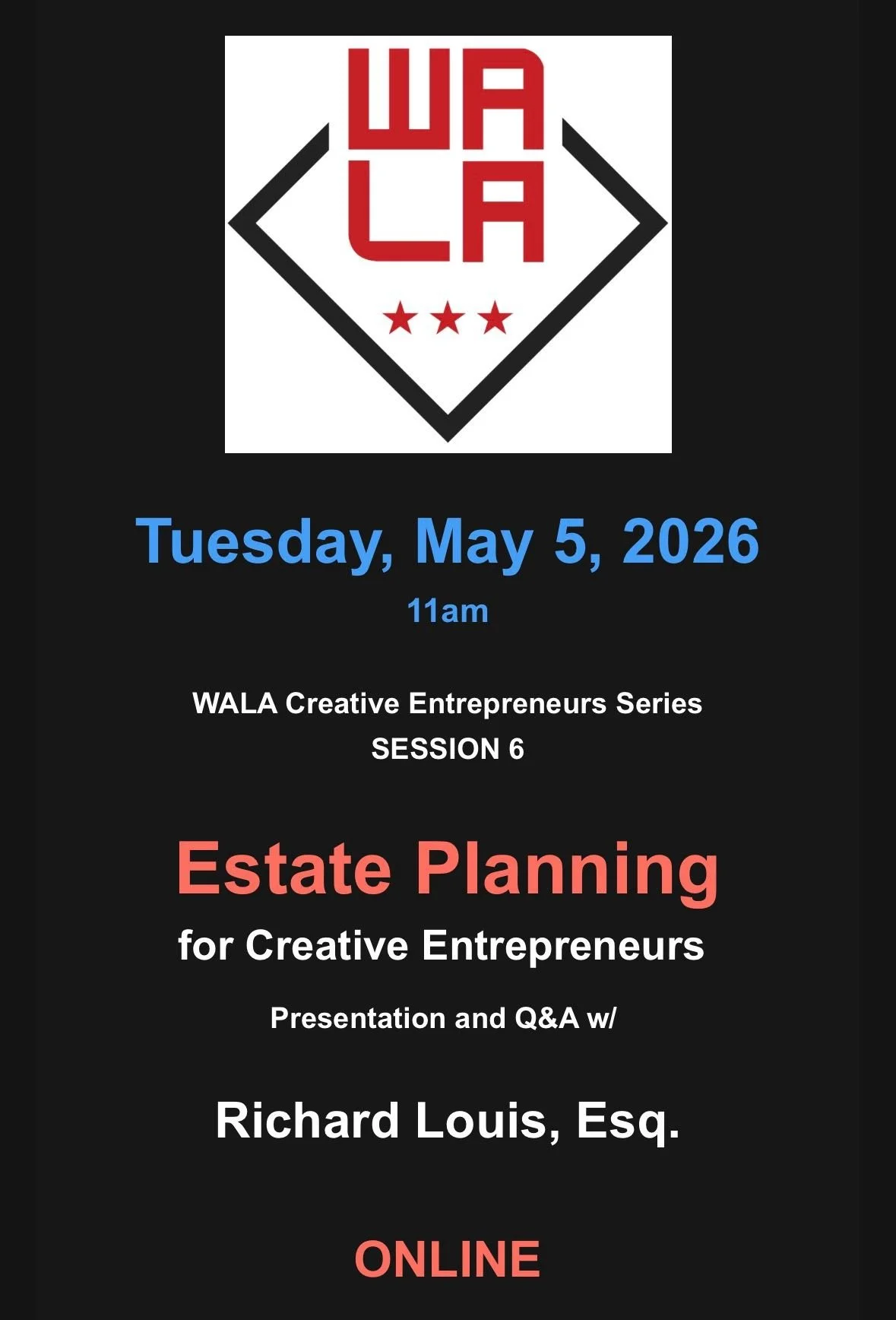
Tuesday May 5th at 11 am, I will be hosting a virtual estate planning session for Artists on behalf of Washington Area Lawyers for the Arts.
Awesome-Con Art Law Panel
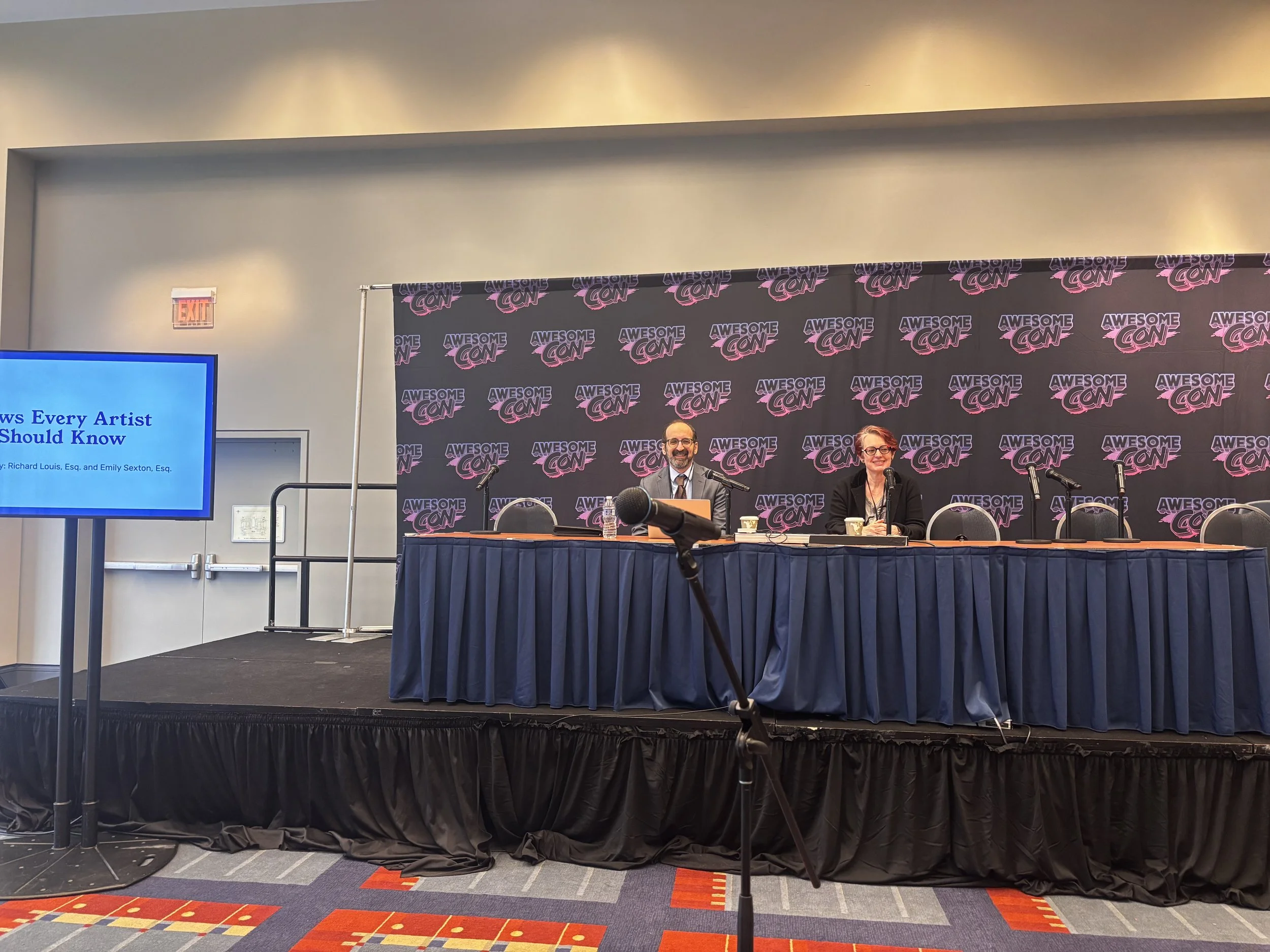
On March 15th, I co-hosted a panel on art law at Awesome-Con in Washington DC with Emily Sexton of Sexton Law. We discussed the very basics of copyright, trademark, and contract law. How arts can organize their businesses and the latest decisions in generative AI law were discussed. We had around great turn out and we are looking forward to presenting next year.
Ink, Images, and the Intrinsic Test: What the Kat Von D Ruling Means for Artists
New year, new art law decisions. Last year, Jeffrey Sedlik (a photographer) sued Kat Von D for copyright infringement for copying his photograph in making a tattoo. The Sedlik lost at the district court level and he appealed the 9th Circuit which recently issued a decision with Sedlik v. Von Drachenberg, No. 24-3367, 2026 WL (9th Cir. Jan. 2, 2026).
The issue on appeal was whether Sedlik was entitled to summary judgment and judgment as a matter of law on the issue of substantial similarity. The Court explained the test for substantial similarity is a two-part test. The first part "assesses the objective similarities of the two works, focusing only on the protectable elements of the plaintiff's expression." The second part "test[s] for similarity of expression from the standpoint of the ordinary reasonable observer, with no expert assistance."
The court emphasized that the intrinsic test is reserved for the finder of fact, while the extrinsic test may, when appropriate, be determined as a matter of law at an earlier stage of litigation. see Funky Films, Inc. v. Time Warner Ent. Co., 462 F.3d 1072, 1076-77 (9th Cir. 2006), overruled on other grounds by Skidmore, 952 F.3d 1051. Both tests must be satisfied for the works to be deemed substantially similar.
The Court affirmed the denial of Sedlik’s motion for summary judgment reasoning that the first part of the substantial similarity test was not a purely legal question. The court also affirmed the denial of Sedlik’s motion for summary judgment reasoning the application of the first part of the test was a triable issue for the jury and reversing it would be tantamount to "supplanting the jury's subjective interpretation with [our] own,"
What should artists take away from this decision? Mainly, that anything can happen at the trial level. The same set of facts could absolutely produce a different result in another jurisdiction. Second, since copyright case as highly fact specific, it unlikely that decisions on key issues (like substantial similarity or fair use) would be reversed on appeal.
Ways to Sue a Generative A.I. Company and (Possibly) Win
A few legal theories that have survived motions to dismiss and could possible allow plaintiff to win against generative artificial intelligence (AI) companies are claims of trademark dilution (federal and state), false endorsement and trade dress (Lanham Act).
State law claims against generative AI companies are generally preempted by copyright right law. see New York Times Co. v. Microsoft Corp., 777 F. Supp. 3d 283, 320 Dist. Court, SD New York 2025. It is in the interest of generative AI companies to get state law claims pre-empted into copyright claims because copyright law has a broad and fact specific fair use defense. see 17 U.S.C. § 107. While trademark dilution, false endorsement, and trade dress have their own defenses (including fair use), they are far less expansive.
In New York Times Co. v. Microsoft Corp., 777 F. Supp. 3d 283, 320 Dist. Court, SD New York 2025, the Court denied Open AI’s motion to dismiss the claims based on trademark dilution (based on federal and state law claims) finding the New York Times pleading that Open AI was using its trademark without authorization on lower-quality and inaccurate writing. See Id. at 323-326.
Even though generative AI models would not use a visual artist in the same manner, a visual artist could win on a motion to dismiss based on a claim of trademark dilution if their art had a watermark (or any other signature) that the large language model reproduced (even if it was a modified version of it). Getty is making a similar claim in their case against Stability AI. see Complaint at 38, 40 Getty Images (US), Inc. v. Stability AI, Ltd., No. 3:25-cv-06891 (N.D. Cal. Aug. 14, 2025).
In Andersen v. Stability AI Ltd., 744 F. Supp. 3d 956 (N.D. Cal. 2024), the Court denied Stability AI’s motion to dismiss the claims based false endorsement and vicarious trade dress infringement. Id. at 977-981. While the false endorsement claim arose from a situation not likely to be repeated (Stability advertised that the model could replicate artists style and specifically referred to them by name), the claim for trade dress is something that could be replicated. Generally trade dress are recognized as "words, symbols, collections of colors and designs, or advertising materials or techniques" that the purchasing public has come to associate with a single source. see Romm Art Creations Ltd. v. Simcha Int'l, Inc., 786 F. Supp. 1126, 1134 (E.D.N.Y. 1992). In Andersen, the Court weighted Stability AI’s references to the artists names as contributing to a finding that the purchasing public has come to associate with a single source, which is unlikely to be repeated. see Andersen, 744 F. Supp. 3d at 977-981. However, there have been other cases where visual artists have been successful in asserting trade dress infringement. see Romm Art Creations Ltd. v. Simcha Int'l, Inc., 786 F. Supp. 1126, 1134 (E.D.N.Y. 1992). One of the hurdles in a claim for trade dress infringement is whether the elements have acquired secondary meaning. However, courts have found that intentional copying of trade dress creates a triable for of secondary meaning. see P&P Imports LLC v. Johnson Enters., LLC, 46 F.4th 953 (9th Cir. 2022). Since the LLMS intentionally copy everything that is available on the internet, this would likely not be an issue.
How can visual artists give themselves the greatest chance in state law or Lanham Act claims? Having a distinctive (but unobtrusive) watermark or signature on anything you post online would likely give artists a fighting chance in court against generative AI under trademark, trade dress infringement, or false endorsement.